BepiColombo Loops Into Orbit Around Mercury, Only the Second Spacecraft Ever to Circle the Planet
Eight years after launch, the European-Japanese mission slipped into Mercury's gravity on Saturday — the innermost planet's first visitor in more than a decade, and the first arrival carrying two science orbiters.
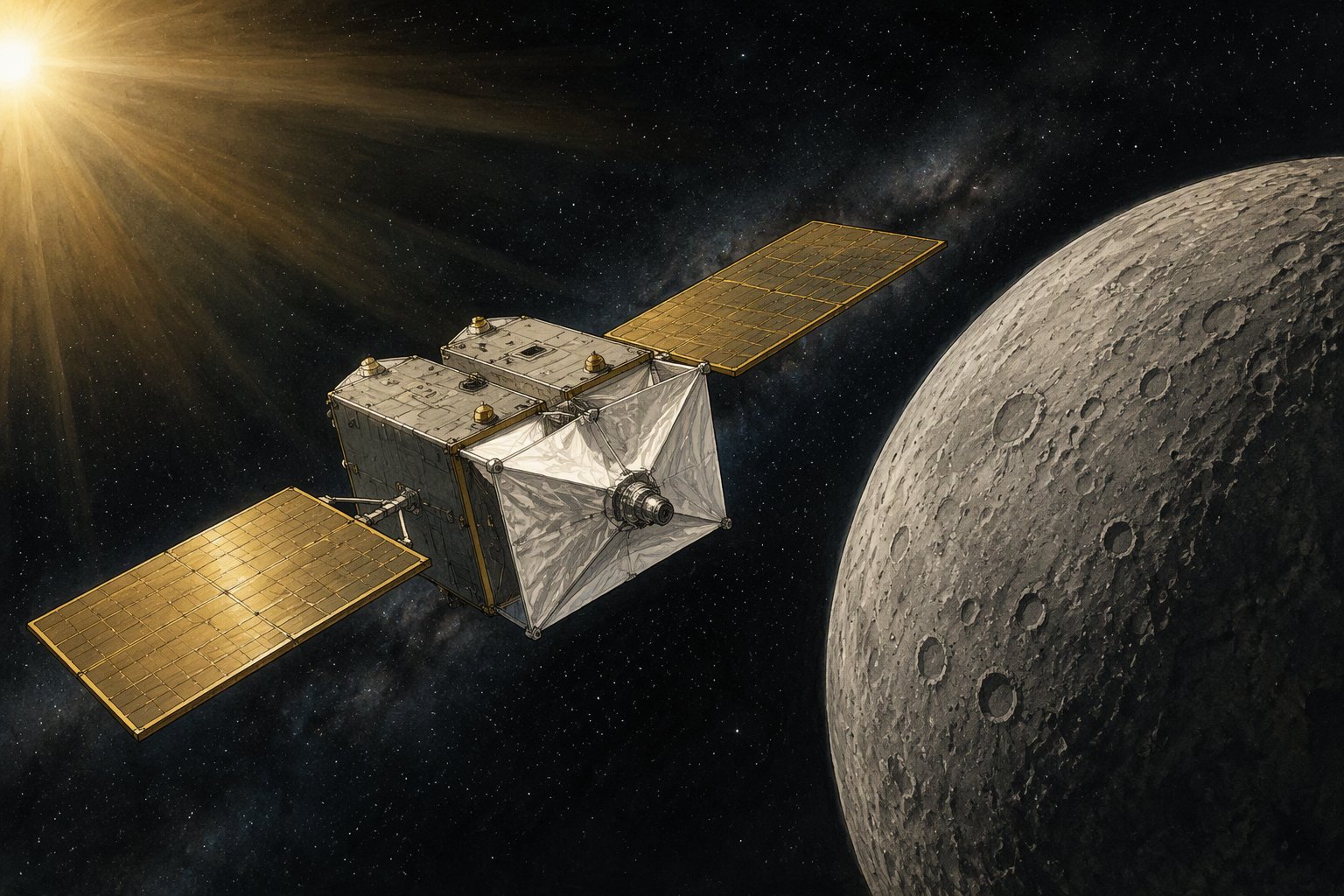
The European-Japanese BepiColombo mission entered orbit around Mercury on Saturday, eight years after launch, becoming only the second spacecraft ever to circle the solar system's innermost planet and the first to arrive carrying two science orbiters, the Associated Press reported.
Four thrusters on the European Space Agency's Mercury Planetary Orbiter fired to slow the spacecraft stack as it approached over Mercury's night side, ensuring capture by the small planet's gravity into an initial elliptical orbit ranging from 590 to 11,640 kilometers above the surface, according to the agency. The maneuver ended a cruise that began with liftoff from Kourou, French Guiana, on October 20, 2018.
Reaching Mercury is one of orbital mechanics' hardest problems: anything falling toward the sun accelerates, so a spacecraft must shed enormous velocity to be captured rather than fly straight past. BepiColombo braked through one flyby of Earth, two of Venus and six of Mercury itself, plus months of ion-engine thrust. The final electric-propulsion arc ended in June 2026, and the transfer module that carried the orbiters separated on September 3, beginning the arrival phase.
BepiColombo will be the first mission flying two spacecraft around Mercury.
The arrival came roughly eleven months later than once planned: thruster problems discovered in 2024 forced controllers to design a lower-thrust trajectory, extending the cruise. ESA and JAXA, the Japanese space agency, split the mission's science between two spacecraft — the Mercury Planetary Orbiter, which will map the surface and study the planet's interior and oversized iron core, and Mio, which will examine the magnetic field and its interplay with the solar wind.
The pair remain stacked for now. They are scheduled to separate on December 9 and 10 — at which point BepiColombo becomes the first mission to fly two spacecraft around Mercury — with further burns to reach the final science orbit by March 2027 and routine science operations beginning in April 2027.
Only two NASA missions have visited Mercury before: Mariner 10, which flew past three times in 1974 and 1975, and Messenger, which orbited from 2011 to 2015 and found water ice in permanently shadowed polar craters. Scientists hope the twin orbiters will explain how a planet so close to the sun formed — and what its history reveals about how rocky planets everywhere take shape.