S&P 500 and Dow Close in Correction as AI Rout Gives Nasdaq Its Worst Week Since 2020
The S&P 500 ended Friday 11.6 percent below its October record after a seventh straight loss, with Nvidia's 14 percent single-day plunge and a near-certain December rate hike leaving Wall Street braced for Monday's open.
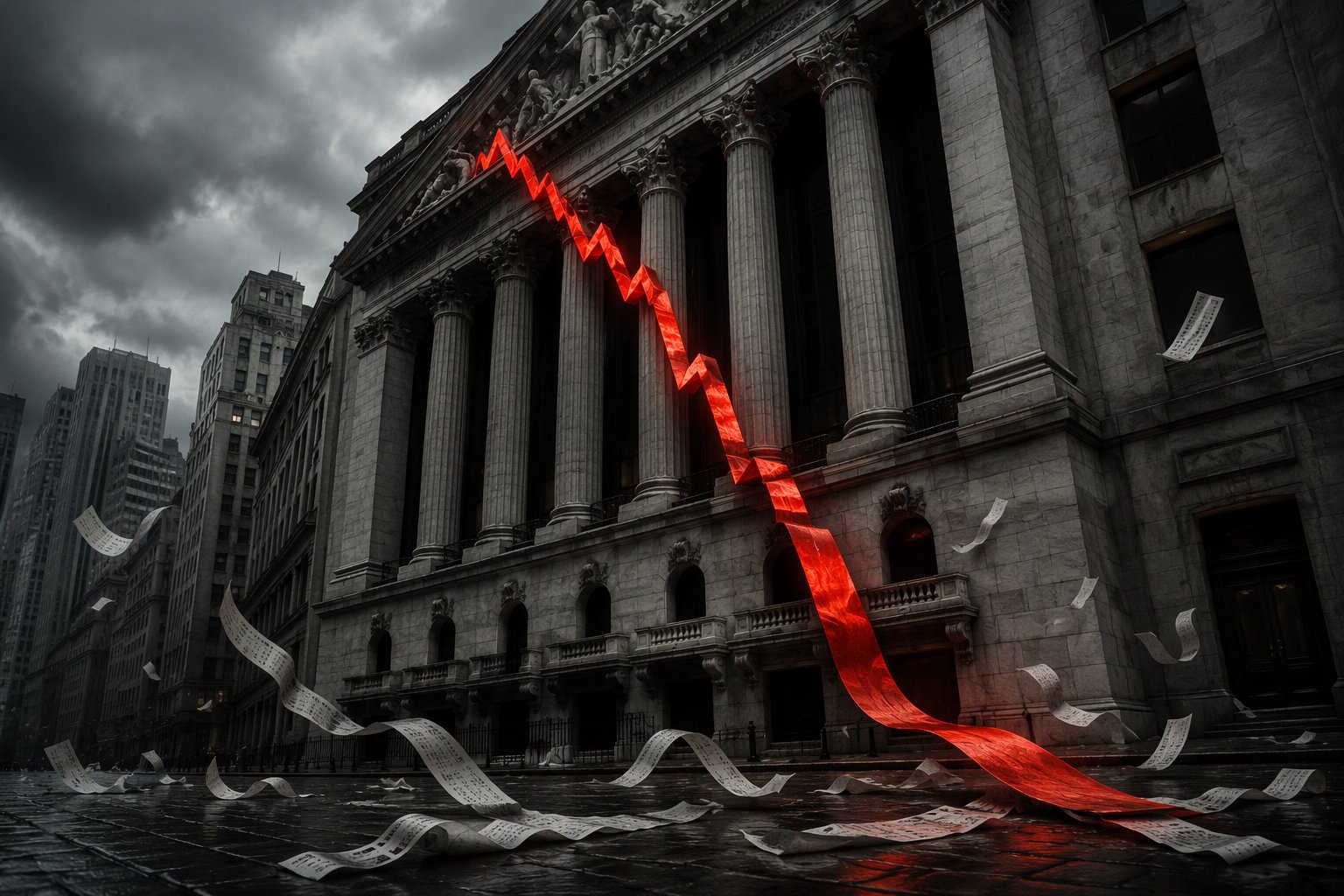
The S&P 500 and the Dow Jones Industrial Average closed in correction territory on Friday, capping the worst week for American stocks since the spring of 2025 as an artificial-intelligence selloff, a reported SEC probe of Nvidia and a Federal Reserve signaling a December rate hike erased trillions of dollars in market value.
The S&P 500 fell 3.7 percent on Friday to 6,910.39, its seventh consecutive decline and longest losing streak since February 2020, ending the week down 8.6 percent and 11.6 percent below its October 6 record close of 7,818.93 — past the 10 percent threshold that defines a correction. The Nasdaq Composite sank 5.28 percent to 22,617.73, its worst week since March 2020, and now sits 18.1 percent below its own October record, negative for the year. The Dow lost 949.73 points to 48,147.33, roughly 10 percent below its record.
Friday's accelerant was Nvidia, whose shares plunged 14 percent after Reuters reported that the Securities and Exchange Commission is examining the chipmaker's accounting; the PHLX Semiconductor Index dropped 10.7 percent in a single session. Anthropic, whose record $81 billion initial public offering debuted Thursday, gave back most of its first-day gain, according to a weekly recap by Vistamark. About $8 trillion in market value has evaporated since the October 6 peak, Yahoo Finance calculated, and the VIX volatility index spiked 26 percent to 35.89, a 52-week high.
Waiting longer to implement rate increases risks getting behind the curve.
The selling was indiscriminate in a way that unsettled strategists. Gold fell about 4 percent on Friday and 9.2 percent for the week, while Bitcoin tumbled below $60,000 — assets that would normally cushion a stock rout falling alongside it. The 30-year fixed mortgage rate jumped to 7.28 percent, the highest since 2001, as credit markets priced persistent inflation; high-yield spreads widened to 347 basis points.
Bond traders, meanwhile, all but locked in a quarter-point rate increase at the Federal Reserve's December 9 meeting, with CME Group's FedWatch tool putting the odds near 92 percent and Polymarket near 91 percent. “Inflation has been above target for more than five and a half years, and every additional day poses greater risk that price- and wage-setters will adjust their inflation expectations upward,” Fed governor Lisa Cook said Friday in Santiago, Chile. “Waiting longer to implement rate increases risks getting behind the curve.” The ten-year Treasury yield fell 13 basis points to 4.91 percent as investors fled to safety.
The week's narrative was relentless: Nvidia dragged the AI trade lower for days despite record revenue, a software rout knocked 850 points off the Dow on Tuesday, Thursday's Anthropic debut sparked an early rally that reversed into an 1,100-point Dow drop, and Friday's slide did the rest. What makes this correction unusual, analysts noted, is the central bank tightening into the drawdown — removing the policy cushion that ended several recent episodes.
Attention now turns to a holiday-shortened week, with trading closed Thursday for Thanksgiving and a shortened session Friday. Treasury Secretary Scott Bessent, speaking on CBS's “Face the Nation” on Sunday, defended the administration's economic record even as Wall Street braced for Monday's open, while Microsoft president Brad Smith faced questions about the technology outages that have rattled consumers alongside the market's losses.