Trump, Xi and Putin Declare 'Nuclear War Cannot Be Won' at First-Ever Trilateral Summit
The three leaders met for more than an hour in Shenzhen and announced a joint peace declaration, in a meeting with echoes of Yalta that left allies watching from the outside.
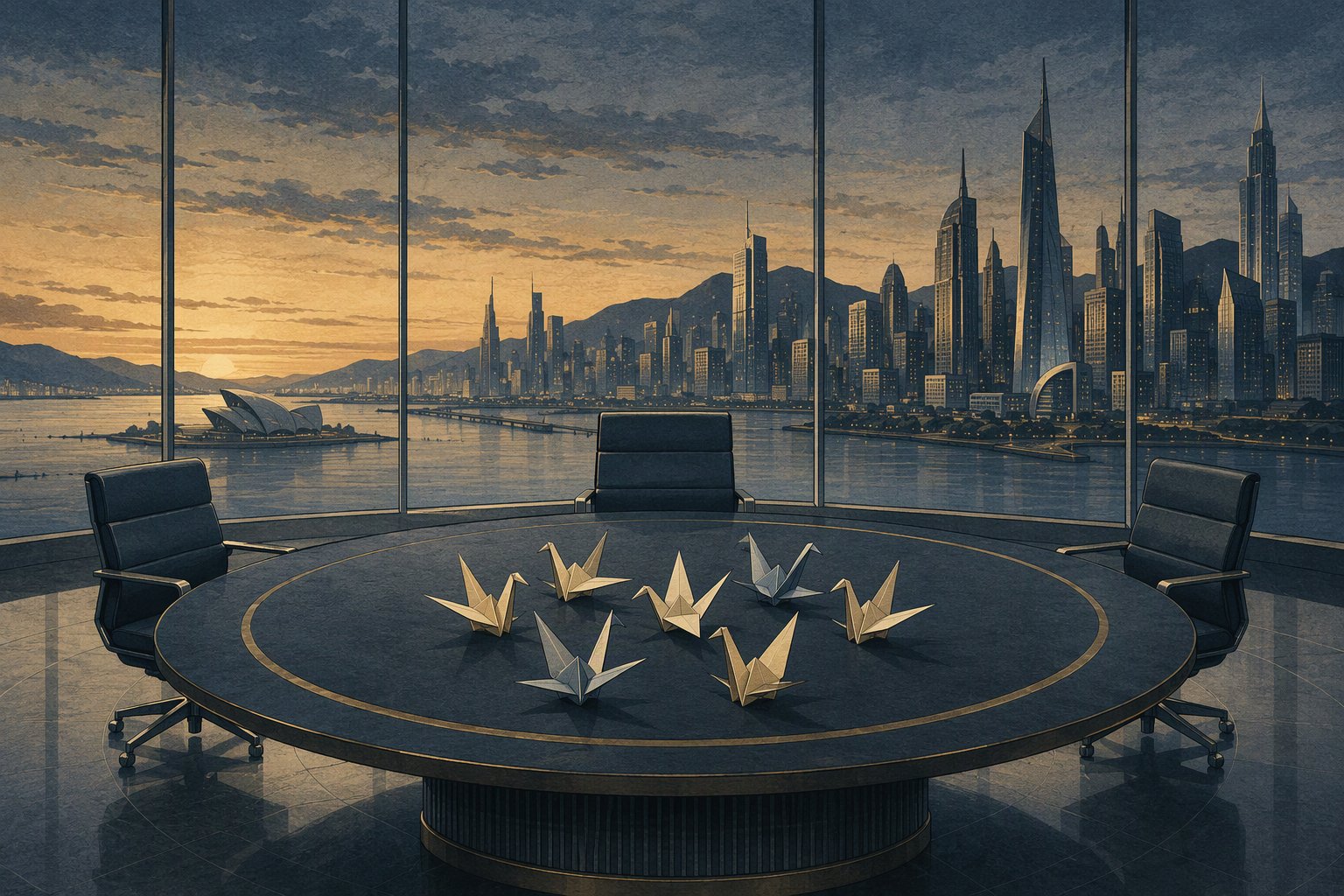
President Trump, Xi Jinping and Vladimir Putin held the first-ever trilateral meeting of American, Chinese and Russian leaders in Shenzhen on Thursday, agreeing that “a nuclear war cannot be won and must never be fought” and announcing a joint peace declaration after talks spanning nuclear arms control and the wars in Iran and Ukraine.
The three leaders met for more than an hour at the Kylin Villa on the sidelines of the Asia-Pacific Economic Cooperation summit, the Associated Press reported, in a session all three described as historic. The Kremlin said the atmosphere of the meeting was “good,” and a joint statement was expected to be published; the three governments announced what reports from the scene described as a peace declaration centered on the principle that nuclear war must never be fought.
The trilateral capped a day of choreography. Mr. Trump first held a bilateral meeting with Mr. Putin at which the war in Ukraine was discussed, then sat down with Mr. Xi for talks on trade, technology and Taiwan that continued over lunch. Mr. Xi told Mr. Trump that China-U.S. relations had remained “generally stable and improved,” bringing “tangible benefits to the people of both countries,” while Mr. Trump hailed his lavish Chinese welcome as a “big win.”
A nuclear war cannot be won and must never be fought.
The meeting, the first time the leaders of the United States, China and Russia have sat down together, drew immediate comparisons to the 1945 Yalta Conference, and arrived with the three presidents pursuing starkly different agendas. American officials had said Mr. Trump wanted to discuss reducing nuclear arsenals and the war in Iran; Beijing had signaled reluctance to put Ukraine on the three-way agenda, with German President Frank-Walter Steinmeier recounting that Mr. Xi showed “irritation” at the idea and insisted Europeans must be at the table for a European conflict.
China's foreign ministry had framed the session as a detailed discussion of safeguarding global peace and strategic stability, with spokesperson Mao Ning saying that better communication between the three powers serves the interests of all. Addressing the APEC summit earlier, Mr. Putin called the trilateral useful, arguing that amid rising military and political risks the world needed “unity instead of division and dialogue instead of threats.”
The summit closed a four-day American presidential swing through Asia that began at the ASEAN summit in Manila and continued with Mr. Trump's arrival in Shenzhen on Wednesday, where Mr. Xi greeted him at the foot of Air Force One's stairs with a red carpet, marching troops and a fighter-jet flypast. It was the fifth meeting this year between Mr. Xi and Mr. Putin. European capitals, which were not in the room, spent the day parsing a joint declaration whose full text had yet to be released.