Hubble Spots a Ten-Sided Pattern at Saturn's South Pole
The geometric feature joins Saturn's famous hexagon in the north as one of the strangest atmospheric structures known on any planet.
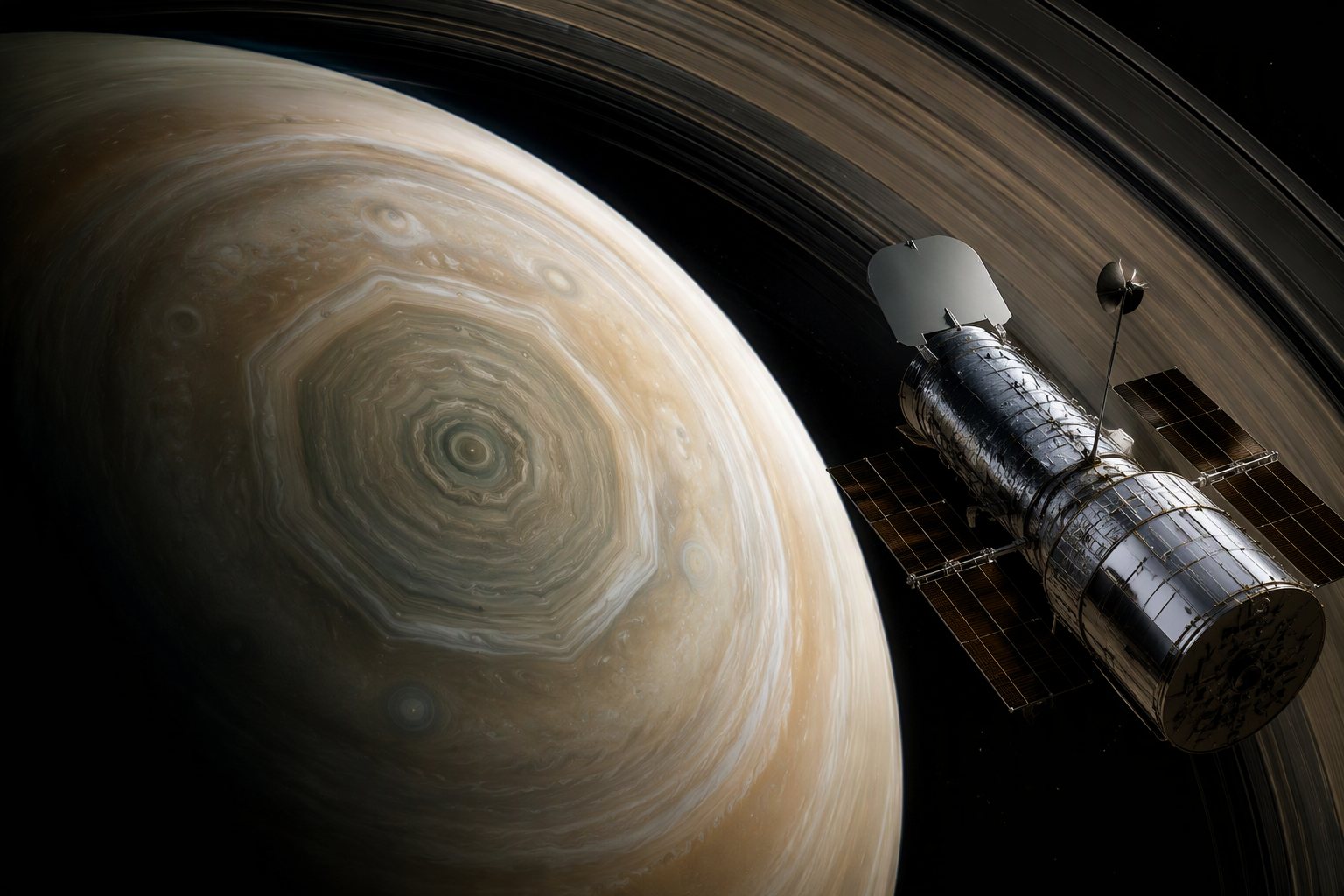
NASA has discovered a ten-sided atmospheric pattern at Saturn's south pole using the Hubble Space Telescope, adding a new geometric oddity to a planet already famous for one.
Saturn's north pole has hosted a stable hexagonal jet stream for decades — a structure with no close parallel elsewhere in the solar system. A ten-sided counterpart in the south deepens the puzzle of how such shapes arise and persist.
Planetary scientists say polygonal patterns can emerge from instabilities in rotating fluids, and that Saturn now offers two natural laboratories for testing those theories at planetary scale.
The observations were made from the Goddard Space Flight Center's programs using Hubble, which, decades after launch, continues to deliver discoveries no ground telescope could have made.